
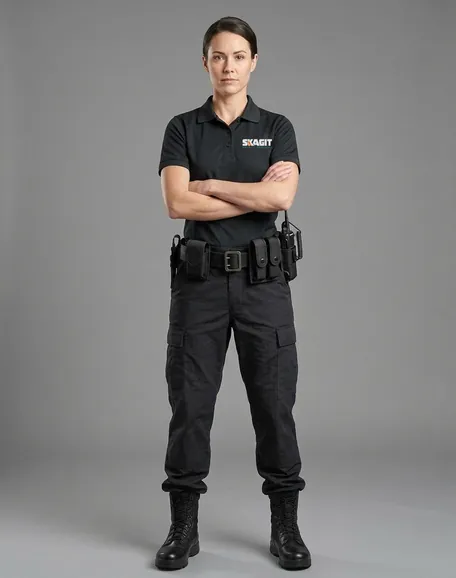
Two kinds of waterfront sites
Some waterfront facilities are regulated under the federal Maritime Transportation Security Act (MTSA) — for example, terminals that receive foreign cargo vessels over 100 gross register tons, ferries and passenger vessels certified to carry more than 150 passengers, or oil and chemical transfer facilities (33 CFR 105.105). Those sites must operate under a Facility Security Plan approved by the Coast Guard.
Many others — most marinas, boatyards, port business parks and small docks — are not. They still have boats, fuel, equipment and people to protect, and they benefit from the same discipline: controlled gates, regular patrols and good records.
Regulated facilities: we follow your security plan
- TWIC for secure areas. Anyone who needs unescorted access to a secure area must hold a Transportation Worker Identification Credential (33 CFR 101.514), and facility personnel with security duties must maintain a TWIC (33 CFR 105.210). We assign officers who hold a valid TWIC to those posts.
- Escorts. Visitors without a TWIC must be continuously accompanied inside secure areas (33 CFR 101.105). Our officers escort and log them.
- ID checks at the gate. At MARSEC Level 1, anyone without a TWIC must show identification and a reason for being there — and can be turned away if they can’t (33 CFR 105.255).
- Records. Facilities must keep security records — including incidents and breaches — for at least two years (33 CFR 105.225). Our logs are written to make that easy.
- MARSEC changes. When the Coast Guard raises the MARSEC level, your plan’s higher-level measures kick in. We can add officers on short notice.
Marinas, boatyards and port properties
- Night dock and parking lot patrols
- Gate checks, after-hours access and key-card door checks
- Fuel dock, haul-out yard and dry storage checks
- Trespass and disturbance response — police called when needed
- Event and season-opening coverage
- A written report for every shift
Port district rules
Washington has 75 public port districts, running marine terminals, marinas, airports and industrial parks. A port district can adopt rules for the use of its properties, which a city or county can make part of its local ordinances (RCW 53.08.220). Give us your rules and our officers will post-brief them and enforce them consistently.
Learn the rules
Not sure whether your site is MTSA-regulated, or what MARSEC levels mean for your gate? Read our plain-English guide: port and maritime security in Washington — TWIC, MTSA and MARSEC.
Where we provide maritime security
Headquartered in Skagit County and serving all of Washington — including Mount Vernon, Burlington, Anacortes, Sedro-Woolley, Concrete, La Conner, Bellingham, Everett, Marysville, Arlington, Oak Harbor, Friday Harbor, Seattle, Bellevue and beyond. See service areas.
Port, Marina & Maritime Security FAQ
Do your officers have TWIC cards?
Officers we assign to secure areas of MTSA-regulated facilities hold a valid TWIC, as federal rules require for personnel with security duties (33 CFR 105.210). Tell us your site is regulated when you request a quote.
Can you escort visitors who don’t have a TWIC?
Yes. Under federal rules, visitors without a TWIC must be continuously accompanied in secure areas. Our officers escort them and log who they were, who they saw and when they left.
Do you provide marina security?
Yes. We patrol docks, parking lots, haul-out yards and gates at night, respond to trespass and disturbances, and write a report for every shift.
Does my marina need a Facility Security Plan?
Usually not. Federal facility security plans apply to facilities that receive certain vessels — such as foreign cargo ships over 100 gross register tons or passenger vessels certified for more than 150 passengers — or that handle regulated oil and chemical cargoes (33 CFR 105.105). Your local Coast Guard Captain of the Port can confirm.